The Government of India reported that cybersecurity incidents increased from 10.29 lakh in 2022 to 22.68 lakh in 2024. It also reported ₹36.45 lakh crore in cyber-fraud amounts on the National Cyber Crime Reporting Portal up to 28 February 2025. These figures include different types of incidents and complaints, so they shouldn’t be read as a direct estimate of losses suffered by every business. They do show, however, how quickly India’s digital attack surface is expanding.
In this case, a small business doesn’t need the security budget of a bank to improve its cyber protection. It does, however, need to stop treating cybersecurity as an optional IT expense. For an Indian business that accepts digital payments, stores customer information, uses cloud software, or relies on email and WhatsApp, a cyber incident can interrupt operations, expose data, damage trust, and create direct financial loss.
Why Small Businesses Are Attractive Targets?
A common misconception is that cybercriminals only target large companies.
enterprises.
In fact, small businesses can be attractive, the following are three reasons:
enterprises.
First, because they often have fewer security controls, shared passwords, old software, limited monitoring, and no dedicated security team. Second, they also hold useful information: customer contact details, invoices, payment records, employee accounts, supplier information, and access to larger partners. Third, the practical lesson is simple: attackers don’t always need to defeat a sophisticated security system. Sometimes they only need one reused password, one unpatched website plugin, one employee to approve a fake payment request, or one laptop without proper protection.
enterprises.
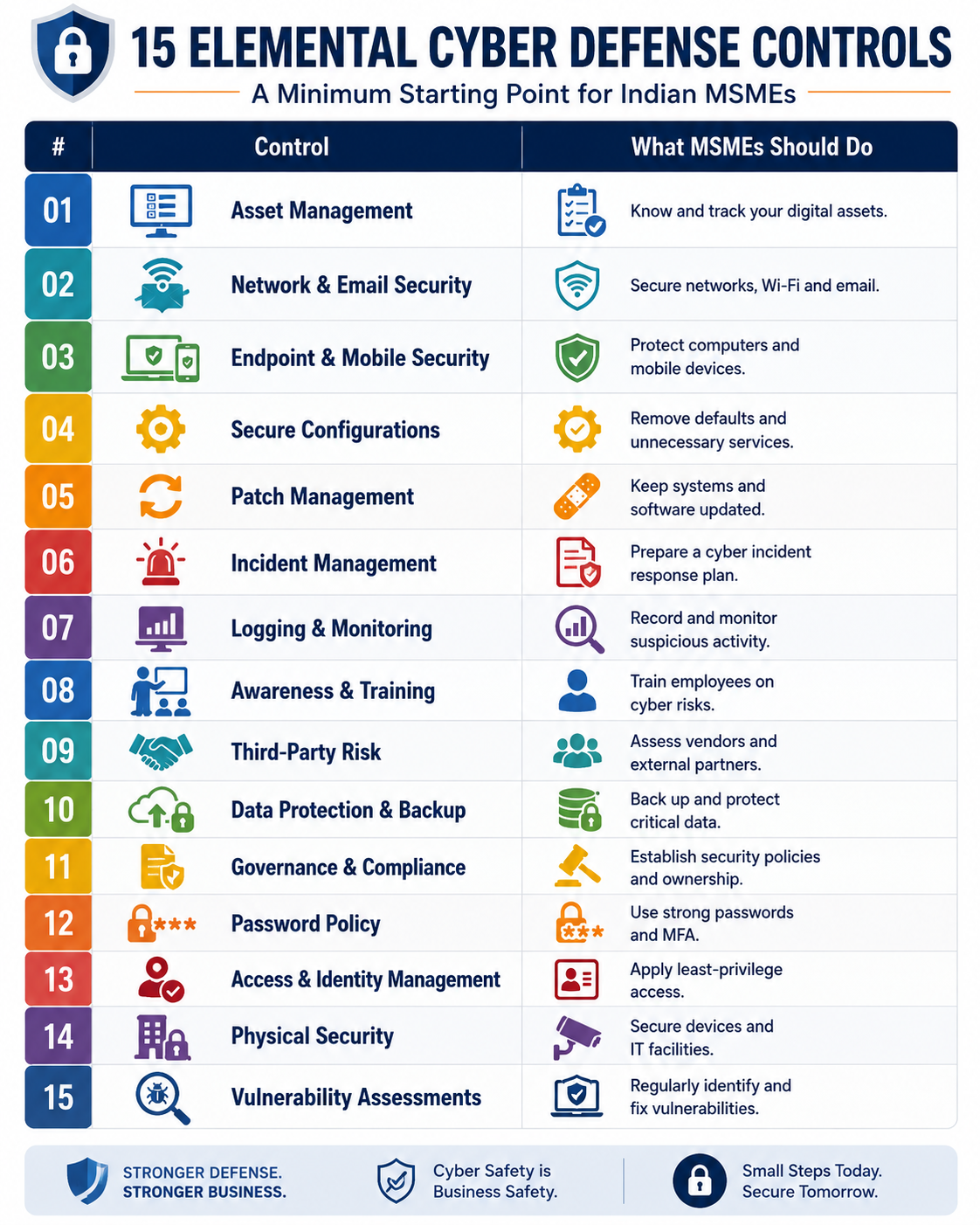
CERT-In’s , (Indian Computer Emergency Response Team), 2025 guidance specifically states that Indian MSMEs are increasingly dependent on digital infrastructure and are therefore important targets for cyber threats. Its document presents 15 elemental controls as a minimum starting point for Indian micro, small, and medium-sized enterprises.
The Minimum Protection Stack
Cybersecurity isn’t one product that you buy once.
This need for continuous protection is especially relevant in 2026. In August, CERT-In issued a critical advisory after observing a significant increase in targeted attacks against Microsoft 365 environments. The campaigns included password spraying, device-code phishing, session-token compromise, and business email compromise, with some techniques designed to bypass MFA. For small businesses relying on cloud email, file sharing, and collaboration tools, this is a reminder that security controls need to evolve as attack methods change.
According to NIST (National Institute of Standards and Technology), it describes it as a continuous process because technologies, regulations, business systems, and threats keep changing. Its small-business guidance recommends multi-factor authentication, strong passwords, backups, updated antivirus, patching, phishing protection, ransomware preparation, and employee training and so on.
The following controls form a realistic minimum protection stack for an Indian small business in 2026.
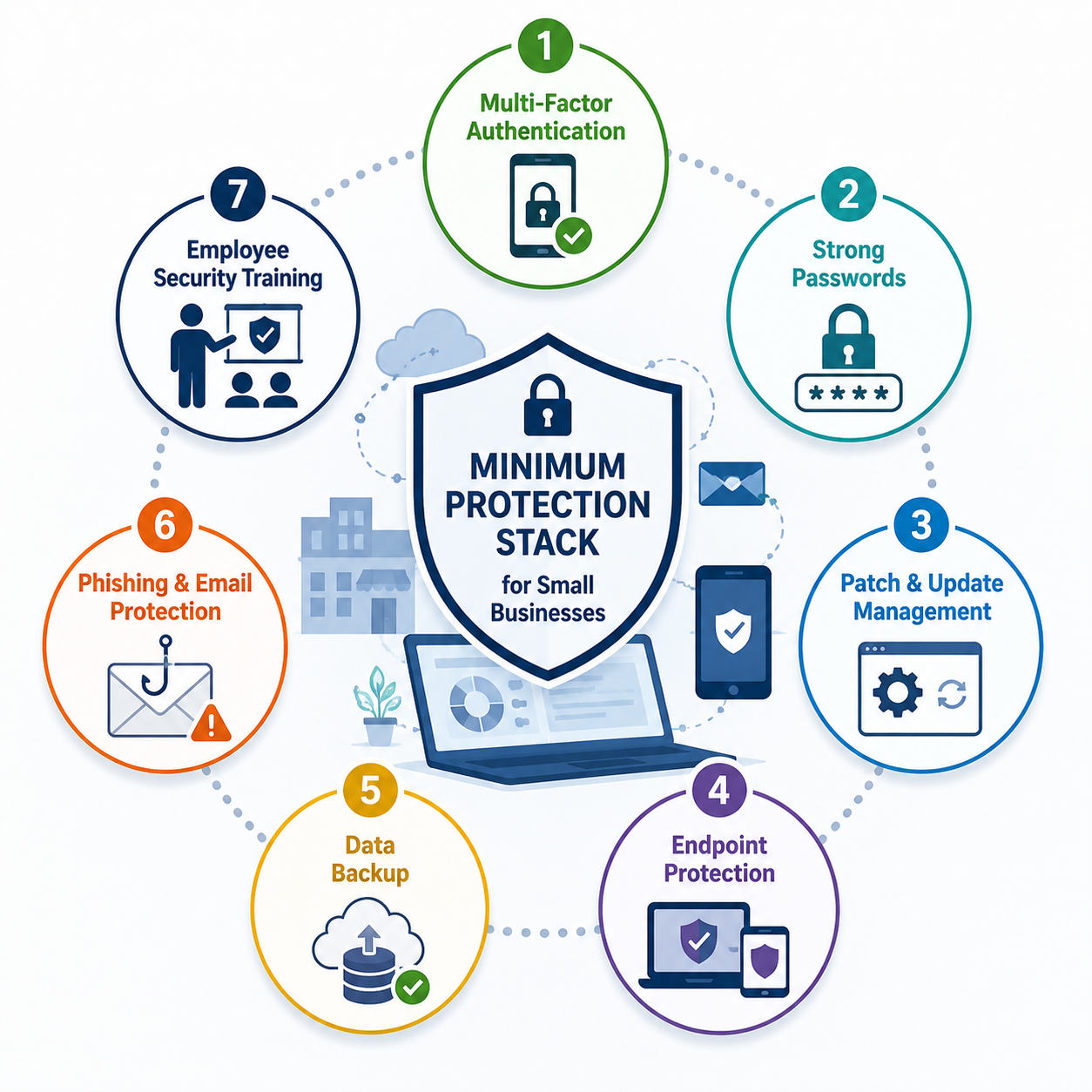
a. Multi-factor authentication,
MFA, Multi-factor authentication, or MFA, adds another verification step after the password. This might be an authenticator-app code, a security key, or a biometric check. If a criminal steals a password, MFA can still prevent access to the account.
According to CERT-In recommends MFA for critical systems, administrative accounts, and remote access. NIST also suggests using phishing-resistant MFA wherever it is available. In that case, we suggest that enterprises enable MFA first on email, banking and payment accounts, cloud storage, administrator accounts, website hosting, CRM systems, and remote-access tools. These accounts can unlock much more than a single device.
b. Strong passwords and controlled access
Shared credentials make it difficult to know who accessed a system and make it impossible to remove one person’s access without disrupting everyone else. So every employee should have an individual account.
Use long, unique passwords and a password manager rather than keeping passwords in spreadsheets, chat messages, or notebooks beside a computer. Based on instructions from CERT-In, the enterprises should use strong passwords, limits on password reuse, account lockouts after repeated failed attempts, and regular access reviews. It also recommends assigning access according to job responsibilities; it’s the principle of least privilege. And what’s Least privilege simply? It means that people should have access to what they need for their work, and not automatically to everything in the company. When an employee leaves, remove access immediately. The same applies to former contractors, agencies, freelancers, and vendors.
c. Backups that can actually be restored
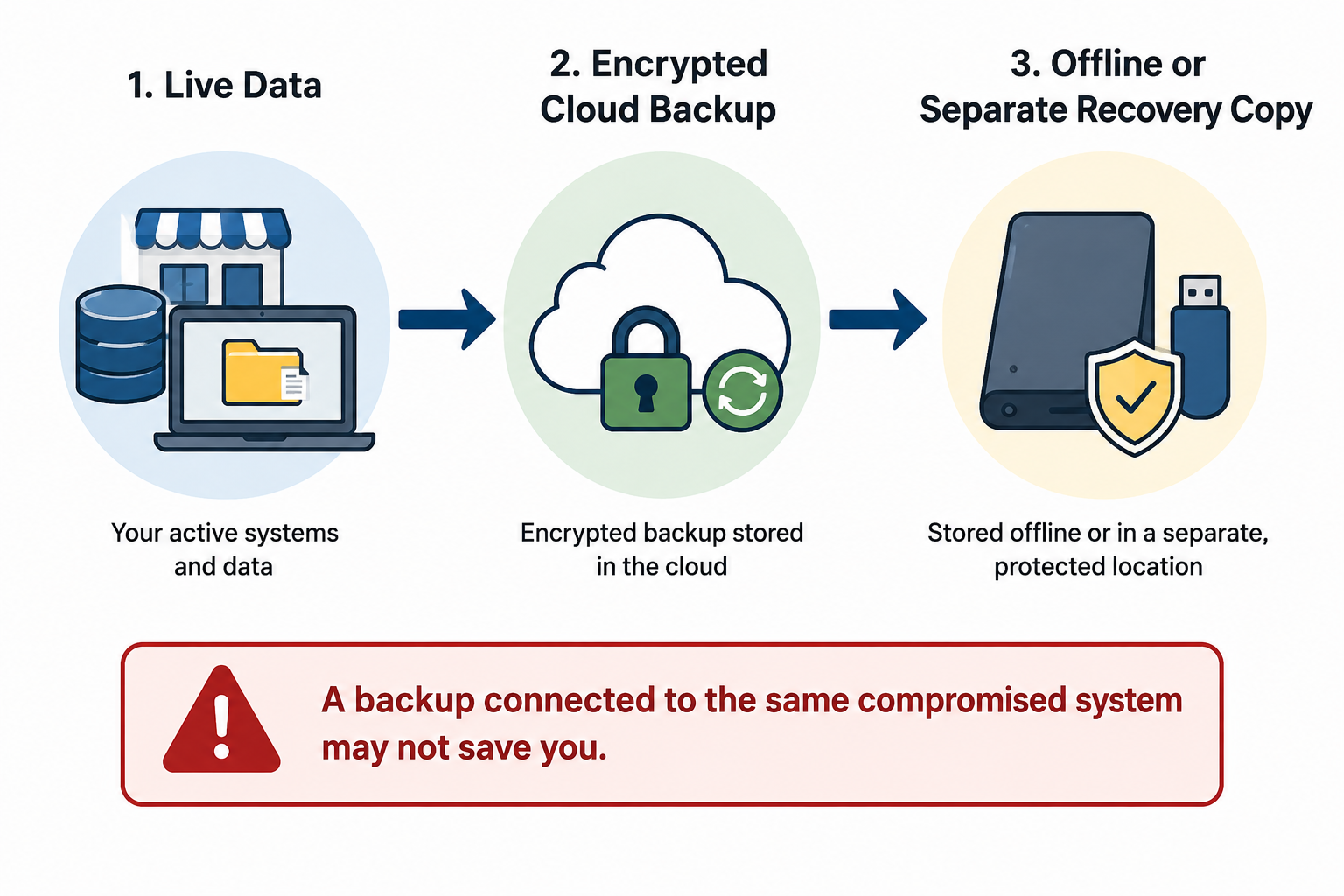
A backup is useful only if the business can recover from it. Many companies discover too late that their backups were incomplete, connected to the same compromised network, or never tested. Keep regular, encrypted backups of essential files and databases. Maintain at least one copy separately from the main system, ideally offline or in a protected environment. CERT-In encourages regular backups, secure offsite and offline copies, periodic restoration tests, and a basic business continuity plan.
For a small business, you can check the recovery question, and those questions should be concrete:
• How much data can we afford to lose?
• How long can we operate without our systems?
• Who is responsible for restoring them?
• Where are the recovery credentials stored?
A ransomware attack becomes far less destructive when the business can isolate infected systems and restore clean data instead of paying under pressure
d. Patching and secure configuration
Patching means applying security updates to operating systems, applications, phones, servers, routers, websites, plugins, and other devices. A patch can close a vulnerability that criminals already know how to exploit. This is not only a theoretical risk. In August 2026, CERT-In warned that a vulnerability affecting Microsoft Windows was already being exploited in the wild and advised users to apply security updates immediately. For small businesses, delaying routine updates can therefore leave known vulnerabilities open to active attacks.
We endorse regularly applying patches and monitoring vendor and CERT-In advisories. It also recommends changing default passwords, disabling unnecessary services and ports, removing unused software, and maintaining approved secure configurations. This is especially important for small businesses using WordPress, ecommerce platforms, remote desktop tools, Wi-Fi routers, accounting software, and third-party integrations. Additionally, an outdated plugin or forgotten administrator account can become the weakest door into the company. Patching shouldn’t depend on someone remembering to do it. Maintain an inventory of hardware, software, domains, cloud accounts, and third-party services, then assign responsibility for updates.
e. Endpoint and mobile security
An endpoint is any device that connects to the business environment: laptop, desktop, phone, tablet, server, or point-of-sale device. Every endpoint is a possible entry point.
Use licensed, supported security software and keep built-in protections enabled. Don’t allow employees to install unapproved applications or use pirated software. Based on CERT-In report, it advises endpoint protection, controlled software installation, malware and botnet alerts, and restrictions on removable USB devices. Moreover, for mobile-heavy businesses, also secure company phones. Use screen locks, device encryption, remote-wipe capability, operating-system updates, and separation between personal and business accounts where possible.
f. Phishing and payment-fraud protection
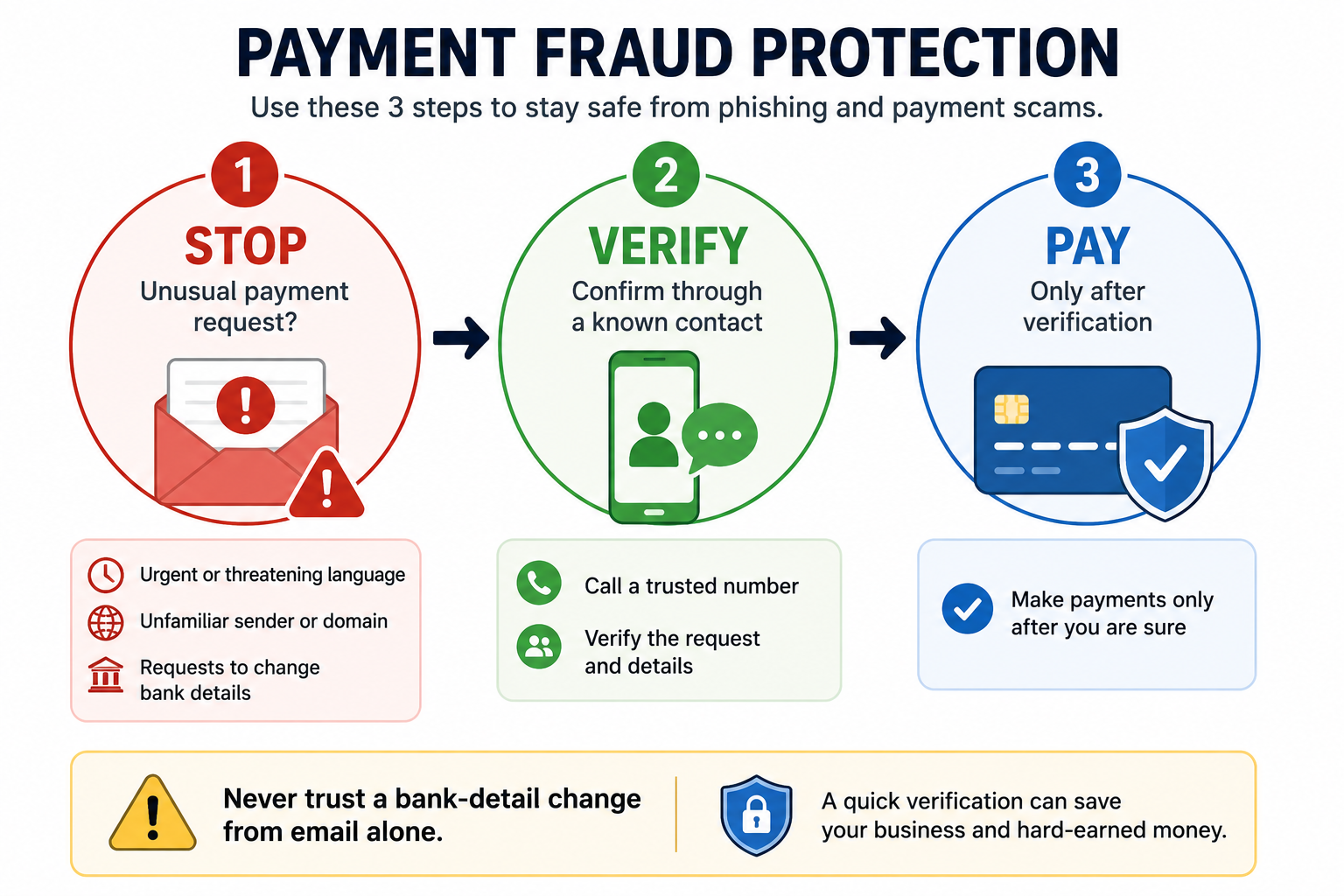
Phishing is a deceptive message designed to make someone click a link, open an attachment, disclose credentials, or transfer money. Today, phishing messages can look professional, use familiar branding, and be written in convincing local language. Artificial intelligence also makes it easier to produce realistic messages, fake documents, and impersonation attempts.
At the same time, the thing of training employees is becoming more important, we also need to train employees how to verify unusual requests, especially requests involving payments, password resets, urgent transfers, or changes to bank details. And also, a phone call to a known number is often safer than replying to the message that made the request. Last, a business should create its own payment-verification rule. For example: no bank-detail change is accepted from email alone, and every high-value transfer requires confirmation through a previously verified contact.
In the recent year, UPI (Unified Payments Interface) has made digital payments fast and convenient, but it has also created familiar opportunities for social engineering. The Government of India lists measures such as device binding, two-factor authentication through a PIN, transaction limits, and fraud monitoring using AI and machine-learning models. It also advises citizens to report financial cyber fraud quickly through the 1930 helpline and the National Cyber Crime Reporting Portal.
g. Email, network, and remote-access security
Email security should include protections against spoofing—messages that appear to come from your domain but don’t. In. CERT-In’s MSME controls specifically mention SPF, DKIM, and DMARC. These are technical email-authentication standards that help receiving mail systems identify whether a message is authorized.
Secure the office Wi-Fi with WPA2 or WPA3, change factory-default credentials, separate guest devices from business systems, and avoid allowing sensitive devices to connect automatically to open networks. For remote access, use encrypted VPN (Virtual Private Network) connections with MFA rather than exposing administrative services directly to the internet.
These measures on the above aren’t excessive for a small company. They are basic ways to reduce the number of doors an attacker can try.
Incident Response and Indian Compliance
Prevention is only half of security.
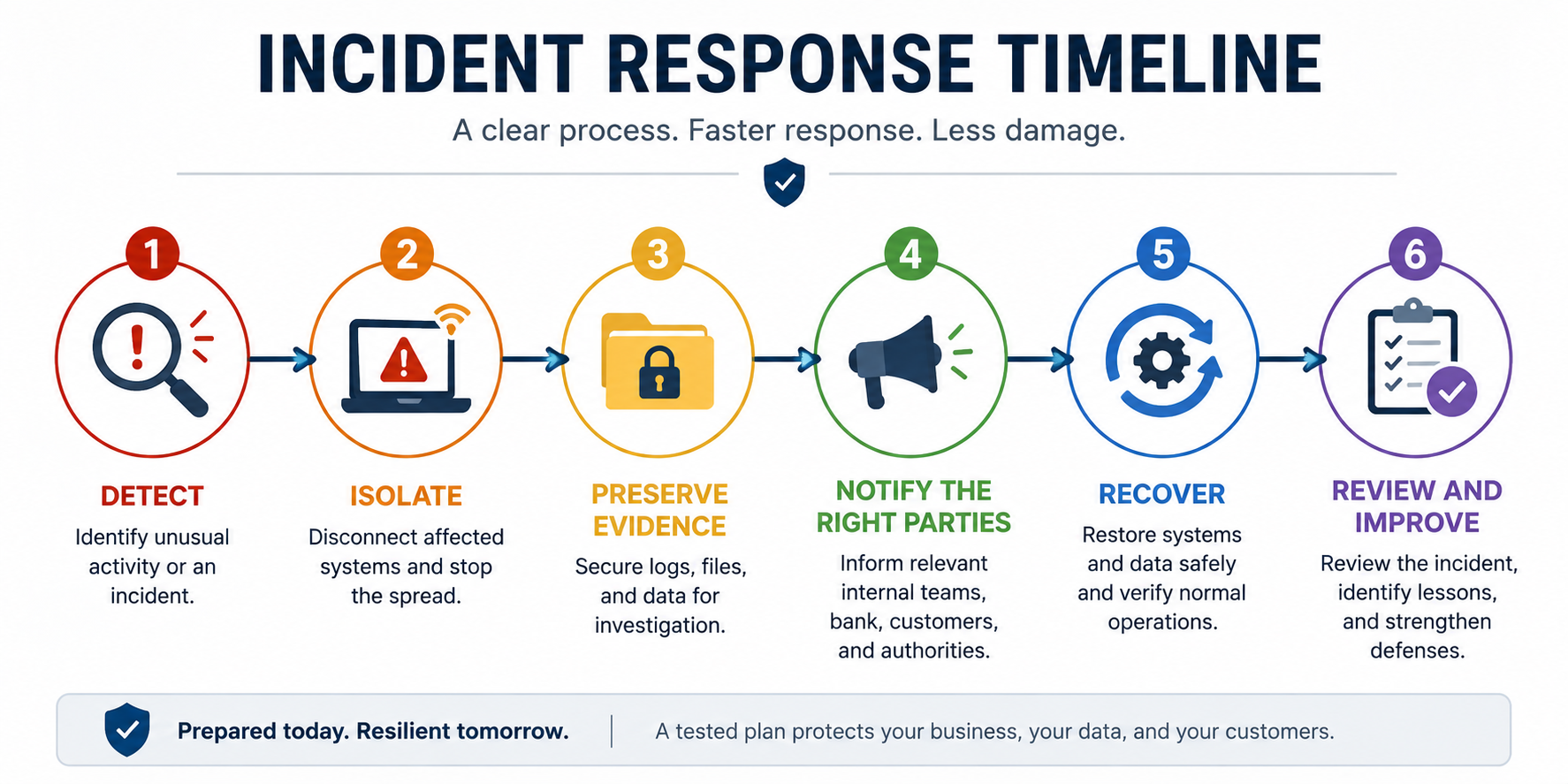
Every business should have a short incident-response plan stating who will disconnect affected devices, who will contact the bank, who will preserve evidence, who will communicate with customers, and who will report the incident.
CERT-In’s MSME guidance recommends a formal incident-response plan, regular testing, and compliance with its directions, including reporting specified cyber incidents to CERT-In within 6 hours of detection or notification. It also suggests retaining key system and application logs for at least 180 days, stored securely within Indian jurisdiction.
Besides following the guidelines from CERT-In’s , this is an area where businesses should obtain professional and legal advice. Because the exact obligations can depend on the sector, systems, type of data, and incident. Additionally, the Digital Personal Data Protection Act, 2023 also makes responsible handling and protection of personal data an important part of India’s digital environment.
The goal isn’t to create paperwork for its own sake. Good logs help establish what happened. A tested response plan reduces confusion. Early reporting can improve the possibility of containing damage.
A Realistic First Step
Laest but not last, a small company doesn’t need to implement everything at the same time. On the basis of CERT-In advices that MSMEs use its controls for self-assessment and consider a baseline audit through a CERT-In-empaneled auditing organisation at least annually.
The following is practical action could conduct first:
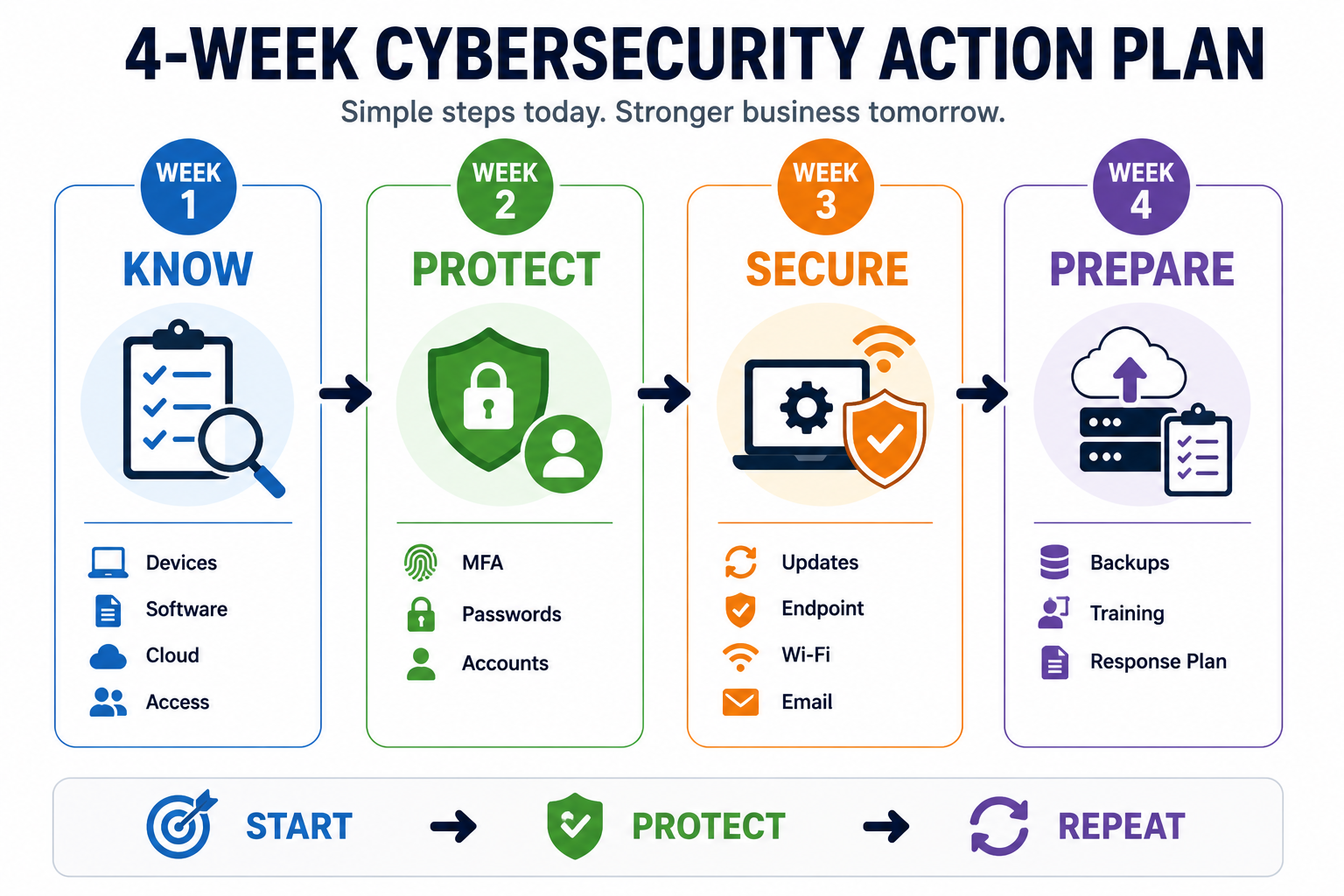
Week one: list all devices, software, domains, cloud accounts, payment systems, and people with administrator access.
Week two: activate MFA, remove shared accounts, change default and reused passwords, and review former employee and vendor access.
Week three: update operating systems and applications, configure endpoint protection, secure Wi-Fi, and verify SPF, DKIM, and DMARC for company email.
Week four: create encrypted backups, test restoring one important file or system, run a phishing-awareness session, and write a one-page incident-response plan.
After that, repeat the process.
Security is Part of the Product
Cybersecurity can’t wait. It must be a top priority for every business.
Cybersecurity shouldn’t be added after a website or mobile app is finished. It should be designed into the product from the beginning: secure authentication, controlled access, protected APIs, encrypted data, safe payment flows, logging, secure hosting, dependency updates, and testing before launch.
For an Indian small business, the minimum acceptable standard in 2026 isn’t perfection. It is preparedness.
The business should know what it owns, who can access it, where its important data is stored, how it will recover, and what it will do when something goes wrong.
Adxania can help businesses build that foundation into their digital systems. Whether the requirement is a secure website, mobile application, cloud platform, payment workflow, vulnerability assessment, or broader cybersecurity support, the objective is the same: reduce avoidable risk without making the technology impossible to use. A secure digital product should protect the business and remain practical for the people who depend on it.
If you’re reviewing your current cybersecurity setup, preparing for compliance requirements, or looking to strengthen the security of your website, application, or cloud environment, Adxania’s cybersecurity team can help you identify the gaps and build a practical security roadmap.