
Should Indian SMEs Build a Mobile App in 2026? The short answer is: yes, but only when the app solves a real business problem that a website, WhatsApp, or a simple web portal cannot solve well enough. Most SMEs do not need an app because “everyone has one”; they need one when it can improve retention, transactions, repeat usage, or operational efficiency in a way that can be measured in money, not just in impressions. That is the mistake many companies make. The better question is not “Can we build it?” but “What does the app do that pays for itself?” For investors and founders, that is the only question that really matters.
Why apps actually work?
Apps work when they remove friction from something people do again and again. If a customer has to reorder, book, check status, pay, message, or log in repeatedly, an app can turn that routine into a faster habit. As we explored in an earlier article, research on mobile apps and customer behavior keeps pointing to the same thing: usability, usefulness, trust, and convenient repeat access. These principles help explain why some apps become part of a customer’s daily routine while others are quickly forgotten. In market like India, studies on digital payment apps show that trust and convenience are especially important because users are often deciding in seconds whether a product feels safe enough to use.
That is the real value of an app. It doesn’t magically create demand. It makes existing demand easier to capture again and again. For a deeper look at the research behind these user behavior principles, read our previous article.
When an SME should invest?
An Indian SME should seriously consider a mobile app when one or more of these are true:
• There is frequent repeat usage, there is a transaction loop,
• There is a need for account-based access,
• There is a service workflow that benefits from push notifications or live updates, or the business wants to reduce dependence on marketplaces and third-party platforms.
The best app businesses are usually not “cool app” businesses. They are businesses where the app reduces friction in a recurring customer journey.
So, ask a very practical question: does the business lose money today because the customer journey is too manual, too slow, or too easy to forget? If the answer is yes, an app may not be a luxury at all. It may be the cheapest way to improve retention and repeat revenue.
What kinds of apps make sense?
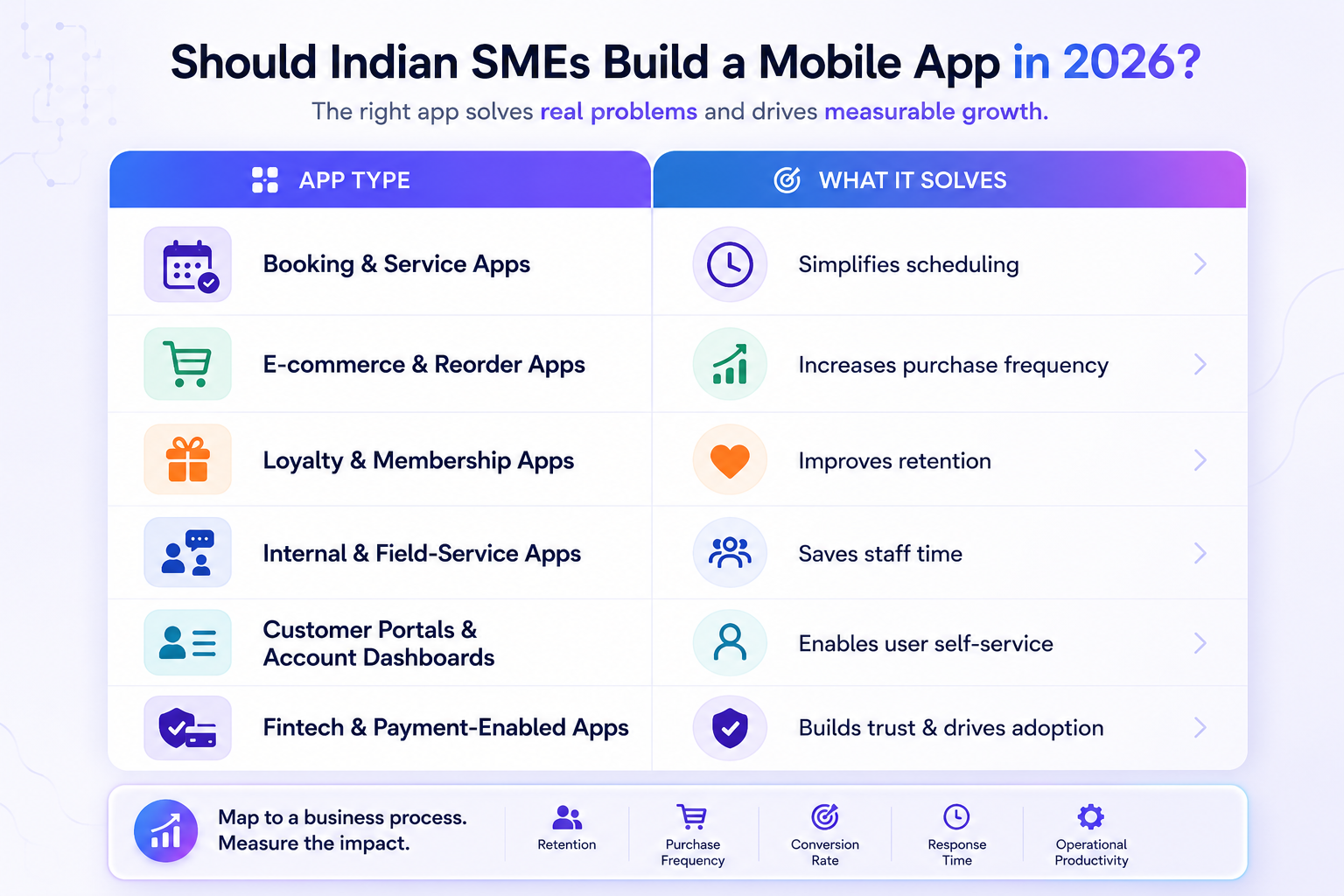
If the answer to those questions is “yes”, the next step isn’t simply to build an app, it’s to determine which type of app best addresses the business problem. The most successful mobile applications are designed around a specific customer journey or operational workflow rather than trying to replicate every feature of a large enterprise platform.
For SMEs, focusing on solving one recurring problem often delivers greater business value than building a feature-rich application. The following are some common examples for reference:
• Booking and service apps that streamline appointment scheduling and customer interactions.
• E-commerce and reorder apps that simplify purchasing and encourage repeat sales.
• Loyalty and membership apps that strengthen customer relationships and improve customer lifetime value.
• Internal operations and field-service apps that improve communication, task management, and workforce productivity.
• Customer portals and account dashboards that provide users with convenient access to orders, subscriptions, support requests, and account information.
• Fintech and payment-enabled apps, where security, trust, and seamless transactions are essential for user adoption.
The reason these work is simple. They map to a business process, not to a vague brand idea. A booking app reduces back-and-forth. A reorder app increases purchase frequency. A loyalty app improves retention. An internal app saves staff hours.Those are measurable gains. Because each solution addresses a measurable business objective, its impact can be evaluated through metrics such as customer retention, purchase frequency, conversion rate, response time, or operational productivity.
What the cost really looks like?
The cost conversation in India is messy because many vendors quote only the build, not the real year-one cost. A more honest view is this: a simple app can start around ₹1.5 lakh to ₹4 lakh, a standard business app often sits around ₹4 lakh to ₹12 lakh, and more complex apps with payments, dashboards, and integrations can go well beyond that. Some guides show lower entry points, but once you add admin work, maintenance, hosting, testing, and post-launch fixes, the real number is usually higher than the first sales quote.
That is why the real budgeting question isn’t “What does it cost to build?” It is “What will it cost to own and operate, and what business value should it generate in return?”Business owners should evaluate an app as a long-term investment rather than a one-time purchase. One practical approach is trying to translate the investment into monthly terms and ask the following questions:
• How much additional revenue should the app generate each month?
• How much cost can it realistically reduce?
• How long should it take to recover the investment?
These questions shift the discussion from technology to business outcomes. For business partners and investors, the priority is rarely whether the company has adopted the newest or most sophisticated technology. Instead, they want to know whether the investment will generate a measurable return and how quickly it will pay for itself.
ROI: The Part Investors Care About

In that case, the question naturally becomes: will the app generate a meaningful return on investment?
The following is the simplest ROI frame.
If the app costs ₹8 lakh to build and another ₹1 lakh to run and improve over the year, the real first-year cost is ₹9 lakh. If it helps the business generate an extra ₹1.5 lakh a month in gross profit through repeat orders, higher conversion, lower support load, or better retention, then the app has paid back in roughly six months. If it only adds a few scattered leads, then it may never earn its keep.That is the language investors understand: payback period, margin, and scalability. Research on app retention shows why this matters so much. Many apps lose most users quickly, so downloads alone are a vanity metric; the real value comes from how many people return and how often they transact.
Additionally, Domino’s provides a good example. Rather than measuring success by downloads alone, the company has focused on creating an app experience that encourages repeat ordering. Today, around 80% of Domino’s orders are placed through its app, and the company reports that customers who order through the app have a 25% higher lifetime value than other customers. This demonstrates that long-term customer engagement is what ultimately drives business value and return on investment, not only rely on the high download volume.
In other words, The app doesn’t need millions of users to be successful. It needs the right users to return consistently and generate enough long-term value for the investment to make financial sense.
ROI: A Real-World Example
A good example is Giro Wallet, one of Adxania’s mobile app projects. Rather than building an app simply to establish a mobile presence, the goal was to create a secure digital wallet that simplifies everyday financial activities within a single platform. The app enables users to pay bills, recharge mobile services, scan QR codes, transfer money, manage loyalty rewards, and monitor their spending. All while maintaining a secure and intuitive user experience.
What makes this a strong business case isn’t the number of features, but how those features work together to reduce friction in everyday transactions. By combining multiple financial services into one application, Giro Wallet encourages repeat usage, increases customer engagement, and builds trust through biometric authentication, end-to-end encryption, AI-powered fraud detection, and compliant identity verification.
This illustrates the difference between building an app and building a business solution. A successful app is not defined by how many features it contains, but by how effectively it solves real customer problems, encourages repeat usage, and creates measurable business value over time. View More Case Studies
If you are an SME founder in India and you are trying to decide whether a mobile app is worth the investment, Adxania helps you judge the idea with a business lens, not just a design lens. On the Giro Wallet project, the app was positioned as a secure, user-friendly digital wallet for iOS and Android. The objective was not to add more features, but to create a solution that simplifies financial activities, encourages repeat engagement, and builds long-term customer trust. In Adxania, every project begins by understanding the business challenge, customer journey, and commercial objectives before recommending the most appropriate digital solution.
Whether you are planning a mobile app, redesigning your website, improving UX/UI, or pursuing a broader digital transformation strategy, the goal should always be the same: building digital products that solve real business problems and deliver measurable business outcomes. That is the principle behind every solution Adxania develops. Talk to us about your goals, and we’ll help you determine whether an app is the right investment for your business.