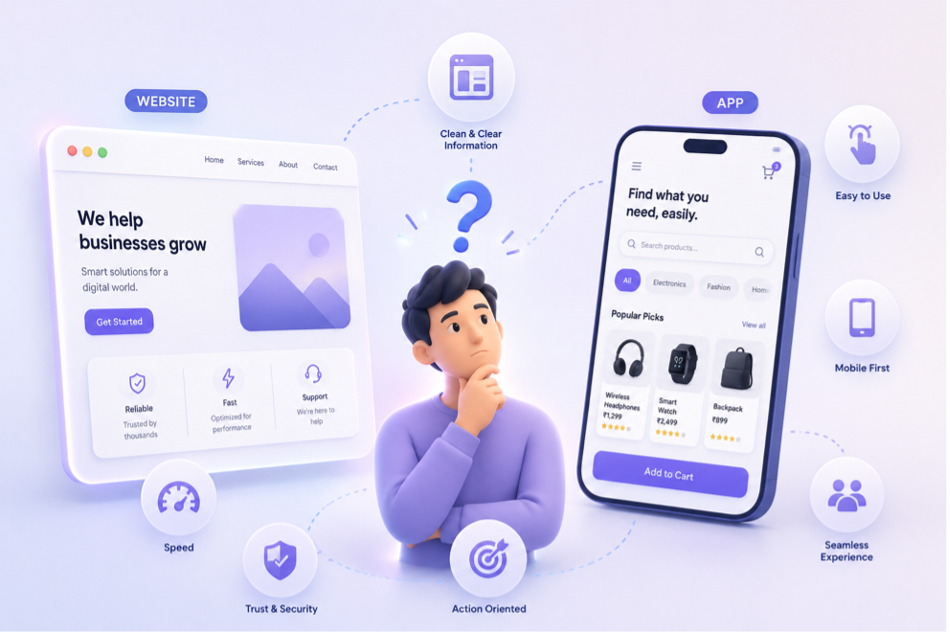
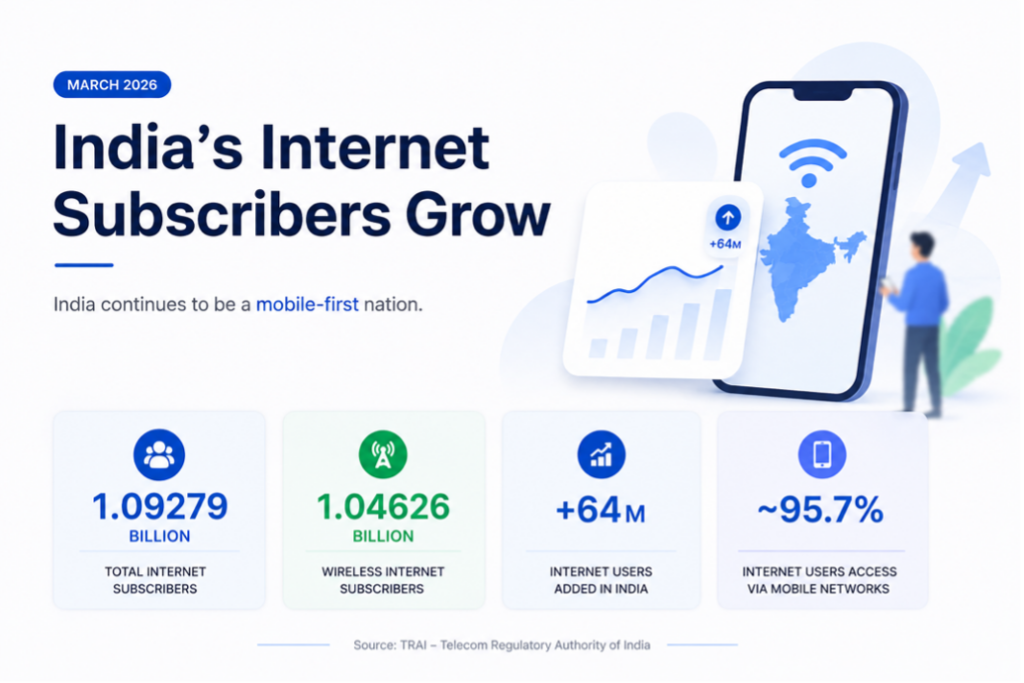
A few years ago, many companies still treated mobile as the smaller version of desktop. That assumption aged badly. In India, the web was never just a desktop story, and the strongest digital products learned that very early. Especially India’s fast-growing digital market, UI / UX design is no longer just about making a product look good. It increasingly shapes how users judge speed, trust, accessibility, and overall usability. According to TRAI’s March 2026 data shows 1.09279 billion internet subscribers in India, with 1.04626 billion using wireless networks, which is why “mobile-first” is not a design trend here but the default condition.
That matters because the user does not experience your brand as a strategy deck. They experience it as a screen that loads fast or fails, a form that feels easy or annoying, a page that feels trustworthy or suspicious. UI / UX is where business intent meets human impatience. So what should we enhance to catch the users eyes?
When Speed Became a Business Feature
One of the clearest examples in India is Flipkart. When it rebuilt its mobile experience as Flipkart Lite, the result was not just “nicer design.” Google’s case study says the new experience led to a 70% increase in conversions, a 3x increase in time on site, and much faster repeat visits, with 63% of users coming from 2G networks at the time.
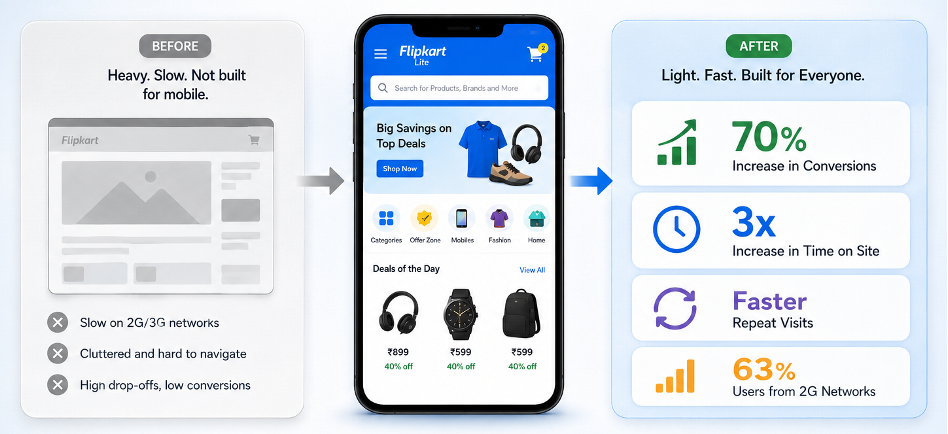
That is the real first lesson: in India, design is often a bandwidth problem, not just a visual one. Additionally, Ola tells a similar story from a different angle. Its PWA helped the company reach users in Tier 2 and Tier 3 cities, with conversion rates in Tier 3 reported as 30% higher than the native app, and first visits around 3.4 seconds even on 2G/3G conditions. The point is not that every business needs a PWA.
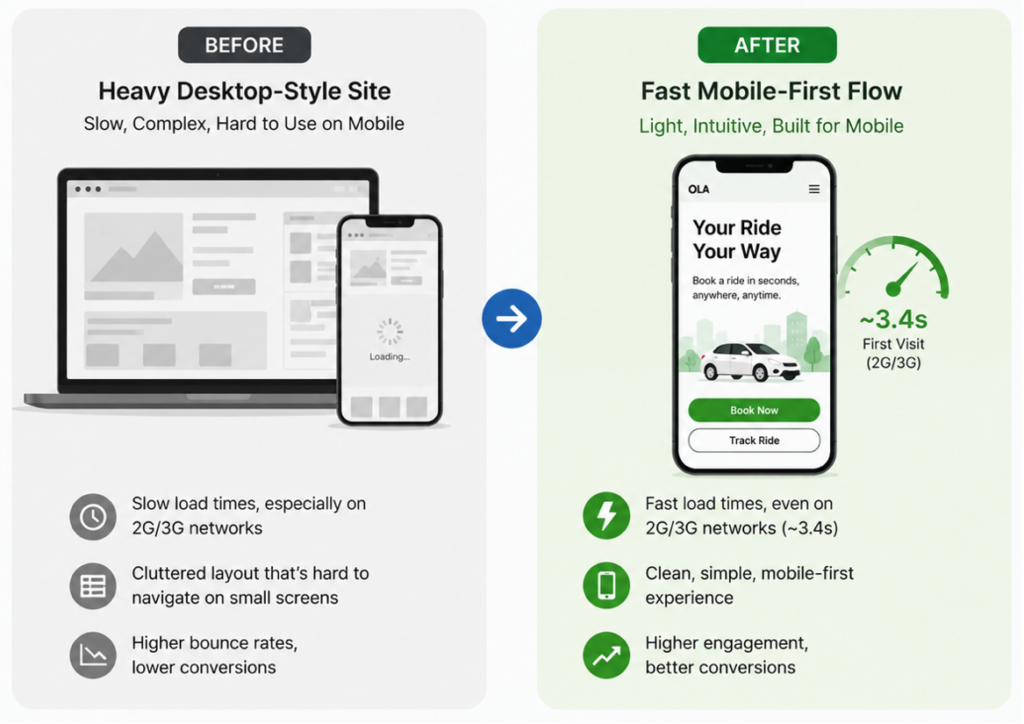
The point is that user experience becomes commercial strategy when the product removes friction in the exact environment where users live, that’s second lesson.
Why Trust Is Part of UI / UX Design
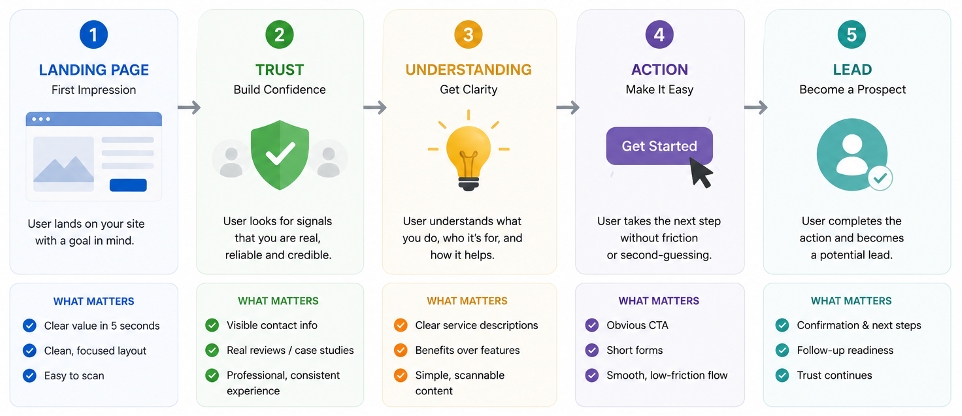
Many websites still try to convert people with polish before they earn trust. That is backwards. Users, especially in service businesses, want proof before action: clear contact details, visible service descriptions, real examples, and a structure that feels deliberate rather than improvised. If the page looks generic, confusing, or over designed, people assume the service will be the same. This is why the best service pages do not hide behind buzzwords. They explain what the company does, who it helps, and what happens next. A good layout makes the next step feel safe. A bad layout makes the user do extra mental work, and extra mental work usually kills conversion.
Friction Is Often The Real Enemy
The most common conversion problem is not lack of interest. It is friction. Long forms, unclear buttons, buried contact options, slow-loading pages, and overly complicated navigation all create tiny moments where the user stops trusting the process. Those tiny moments add up.
In an era of information overload, where attention is increasingly fragmented and every brand competes for a limited share of it, reducing friction throughout the user journey has become more important than ever. Capturing attention is only the first step; the real challenge is making it easy for users to take action.
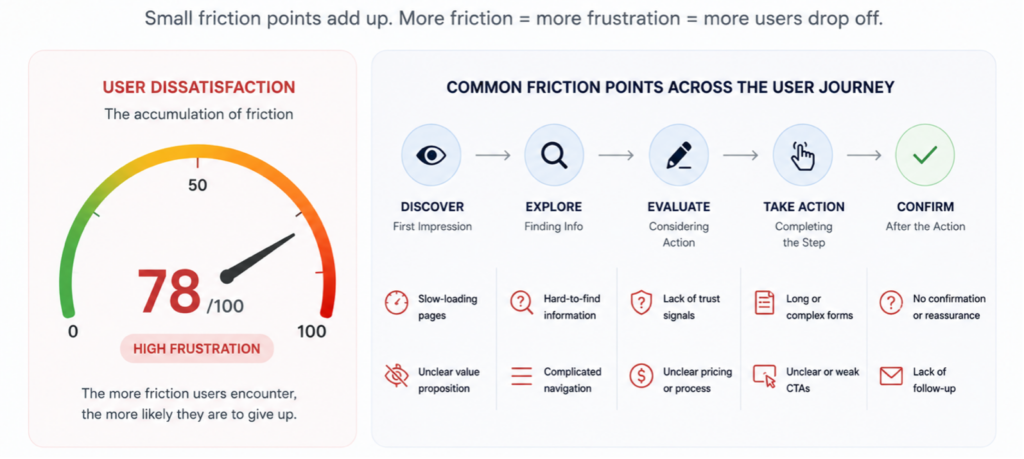
That is why good UX often looks almost boring. Short forms outperform long ones because they respect attention. Clear CTAs outperform clever copy because they remove doubt. Better navigation outperforms “creative” menus because people can find what they need faster. The goal is not to impress the user with complexity. The goal is to make action feel effortless.
For example, a website is not a brochure anymore. It is closer to a salesperson who gets one chance to be clear. If the salesperson talks in circles, the customer leaves. If the salesperson is sharp, calm, and obvious, the customer stays.
What Changed in The Market
The interesting shift in recent years is that users now compare everything to the best experiences they have had elsewhere.
They don’t compares your small business website only to competitors. They compare it to Amazon, Flipkart, Ola, and every app that made a task feel simple. Once users get used to fast checkout, clear progress indicators, and low-friction login flows, they carry those expectations. That is why the strongest design teams now think less in terms of pages and more in terms of journeys. Can the user understand the value in 5 seconds? Can they move from curiosity to action without confusion? Can they trust the business enough to leave their details? If the answer is no, the design is not doing its job.
The Next Evolution of UX
When UX is no longer just about design, how can business move from User-Friendly to AI-Ready Experiences?
AI is starting to change UX in ways that go far beyond simple personalization. Instead of showing every visitor the same fixed layout, smarter interfaces can now adapt in real time. For example, AI can detect when a user is hesitating, simplify the next step, surface the most relevant content, or even reduce unnecessary choices before friction becomes a barrier. As a result, websites are no longer just information platforms. They are becoming intelligent assistants that guide users, recommend the next step, and help them achieve their goals more efficiently. Great UX is no longer measured by how a website looks, but by how easily users can complete their journey.
For businesses, this means UX/UI is no longer just about creating a modern-looking website. It is about designing digital experiences that build trust, reduce friction, and turn visitors into customers. That means clearer service pages, better mobile experiences, faster navigation, and interfaces that reflect how people actually browse today.
If you want to know whether a website is good, don’t ask whether it looks impressive on a laptop. Ask whether a tired person on a phone, with average internet, can understand it and act on it in under a minute. Moreover, A great project isn’t just a redesign. It is a conversion problem solved through design. This means UX/UI is no longer just about creating a modern-looking website. It’s about designing digital experiences that build trust, reduce friction, and turn visitors into customers.
From Theory to Practice: A Real-World Example
A real-world example of this approach is Adxania’s collaboration with Aluplast India. Rather than simply implementing new technology or redesigning digital touch points, the project focused on connecting CRM, marketing automation, and business processes to create a more seamless customer journey. By improving visibility across customer interactions and streamlining lead management, the solution helped increase customer engagement, improve marketing efficiency, and reduce time-to-market by 40%. It demonstrates that successful digital experiences are built by aligning technology, business processes, and user needs.
At Adxania, we believe digital experiences should create measurable business value. Whether it’s UX/UI design, website development, AI solutions, or digital transformation, our goal is to help organizations build connected digital ecosystems that improve customer engagement, increase operational efficiency, and support long-term business growth.
If you’re exploring how better digital experiences can strengthen customer trust, improve conversion, or support your digital transformation journey, we’d be happy to start the conversation.